.svg)
What Is the Best Mother’s Day eCommerce Strategy for Shopify Brands?
The best Mother’s Day eCommerce strategy for Shopify brands is optimising for proxy buyers, simplifying gift discovery and increasing validation signals rather than relying on heavy discounting.
Successful brands remove decision friction by introducing curated gift bundles, collaborative sharing tools and proxy-friendly checkout experiences, allowing customers to confidently purchase gifts for mothers without hesitation.
At WIRO, we see one recurring issue every seasonal gifting period: brands design their experience for solo buyers, when the real decision often happens in a family WhatsApp group.
The result? Lost conversions, abandoned carts and missed revenue opportunities during one of the UK’s biggest seasonal gifting events.
Why Mother’s Day Is One of the Biggest Missed Opportunities in UK eCommerce
Mother’s Day generates over £1.6 billion in retail spending in the UK, according to data from the Office for National Statistics.
Yet most brands still treat the event like a simple campaign:
- Homepage banner swaps
- Floral design updates
- Small percentage discounts
That isn’t strategy. It’s decoration. The real problem is structural.
Most brands assume one customer lands on the site, browses products and purchases independently.
But Mother’s Day shoppers rarely behave this way.
Instead, they operate as proxy buyers.
These are customers who:
- Buy on behalf of siblings or family members
- Send product links in group chats
- Seek validation before purchasing
- Shop during short, distracted windows of time
If your product pages fail to immediately signal “this is the right gift”, the decision stalls and the purchase disappears.
At WIRO, we call this phenomenon the Invisible Decision-Maker problem.
The Invisible Decision-Maker: The Hidden Influence Behind Gift Purchases
During seasonal gifting events, the real decision often happens outside your website.
A customer might:
- Discover a product on your site
- Share the link in a family WhatsApp group
- Wait for validation from siblings or partners
- Return later to purchase
If the shared product page doesn’t instantly communicate value, quality and “gift suitability,” the conversation ends.
This is where many Shopify stores lose conversions.
The invisible decision-maker, the person reviewing the link arrives on the page with no brand context and no emotional connection to your store.
Your product page must immediately answer:
- Is this a safe gift choice?
- Does it look premium?
- Will Mum actually like it?
If those answers aren’t obvious, the purchase rarely happens.
How Successful Shopify Brands Win Mother’s Day Without Discounting
Discounts are the laziest lever in eCommerce.
The most successful Shopify brands focus instead on removing decision friction.
Here are the strategies that consistently outperform discount-led campaigns.
1. Curated Gift Sets Increase Average Order Value
Proxy buyers do not want to build a gift.
They want a ready-made solution.
Curated gift bundles eliminate the need to compare individual items, helping customers make faster decisions.
For example, flower delivery brand Bloom & Wild simplifies gift selection by highlighting curated arrangements and popular seasonal options.
Instead of browsing dozens of products, shoppers see:
- Best-selling bouquets
- Letterbox-friendly flowers
- Seasonal gift collections
- Free delivery before Mothers day
This approach dramatically reduces decision fatigue.
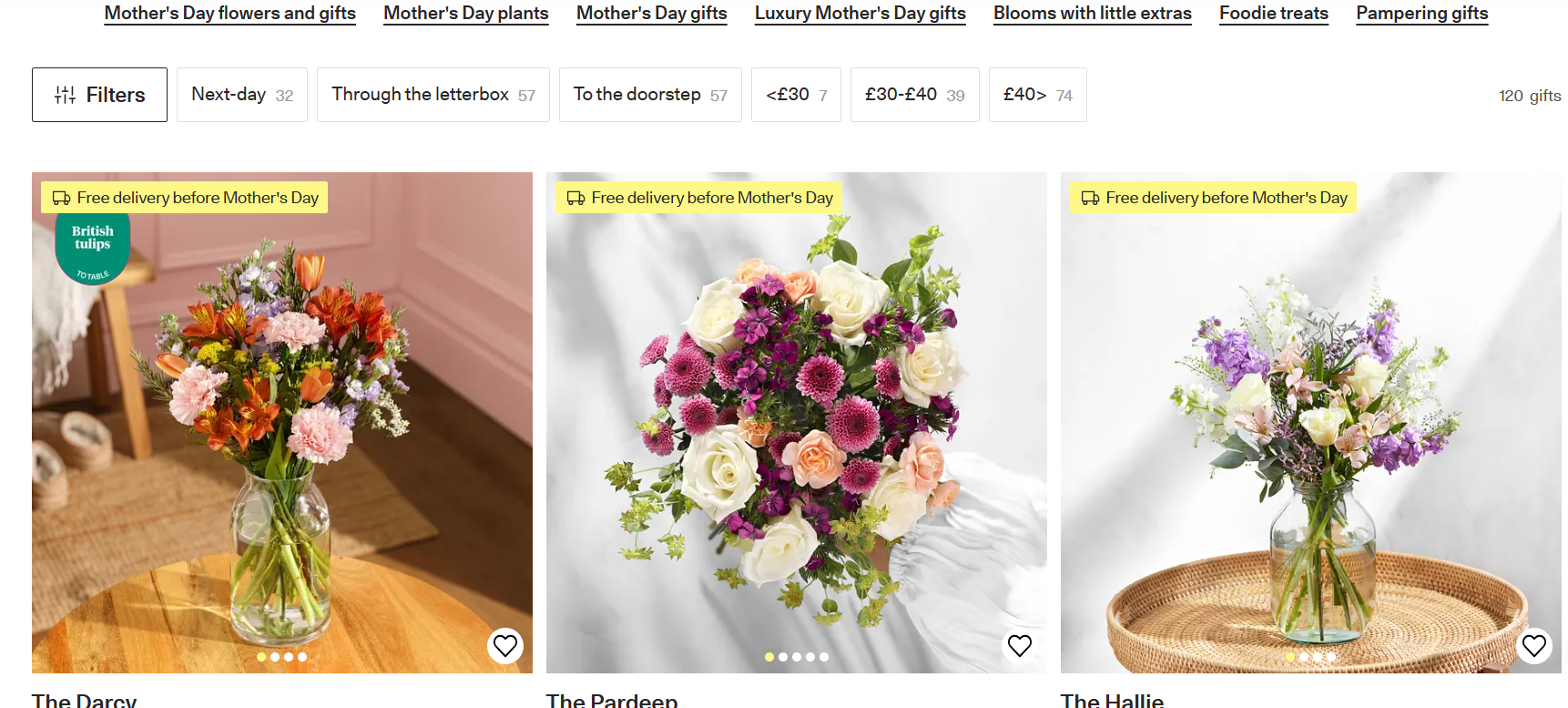
For Shopify brands selling skincare, beauty, homeware, or lifestyle products, curated bundles can increase AOV by combining complementary products.
Example bundle structure:
- Candle + diffuser + handwritten card
- Skincare trio set
- Afternoon tea gift hamper
When the bundle becomes the “default gift,” conversions increase naturally.
.png)
2. Validation Signals Help Buyers Make Faster Decisions
Mother’s Day shoppers want reassurance.
They want confirmation that they’re making a safe choice.
This is why validation signals outperform long product descriptions.
Examples include:
- “Most Gifted for Mother’s Day”
- “Top Rated Gift Set”
- “Editor’s Pick”
- “Customer Favourite”
These signals reduce the cognitive effort required to choose.
They also create social proof, which is essential when customers are buying for someone else.
.png)
3. Collaborative Shopping UX Improves Conversion
Modern shoppers rarely decide alone.
They consult:
- Partners
- Siblings
- Family members
Yet most eCommerce stores still treat shopping as an individual activity.
A simple improvement is enabling easy product sharing.
For example:
- “Share with family” buttons
- WhatsApp share options
- Copyable product links
When customers can validate their choice in seconds, the path to purchase becomes much shorter.
4. Gift-Friendly Checkout Reduces Friction
One of the most overlooked areas of Mother’s Day UX is the checkout.
Remember: buyers are rarely sending the gift to themselves.
Yet many checkout flows assume shipping and billing addresses are identical.
This creates unnecessary friction.
A better checkout experience includes:
- A “Send as a gift” toggle
- Separate shipping and billing fields
- Gift message functionality
- Hidden prices on packing slips
These small UX improvements can significantly increase conversion rates during gifting events.
.png)
Seasonal gifting traffic often exposes weaknesses in checkout UX. Optimising this stage is critical, particularly when proxy buyers are purchasing for someone else. Our guide on how to optimise checkout processes to reduce cart abandonment explores this in more detail.
5. Post-Holiday Retention Is Where Real ROI Happens
Mother’s Day isn’t just about seasonal revenue.
It’s also a powerful customer acquisition opportunity.
Many proxy buyers discover brands they’ve never purchased from before.
The mistake most retailers make is going silent after the shipping deadline passes.
Smart brands instead use this moment to retain customers.
Examples include:
- Post-delivery emails validating the purchase (“We hope she loved it.”)
- Early promotions for Father’s Day
- Personalised product recommendations
The goal is simple: turn a one-time proxy buyer into a repeat customer.
Example: How a Shopify Brand Could Optimise Mother’s Day
Imagine a UK skincare brand running on Shopify Plus.
Instead of launching a generic Mother’s Day sale, the brand could implement:
Homepage
- “Top 5 Mother’s Day Gift Sets”
- Clear shipping cut-off countdown
Product Pages
- “Most Gifted This Year” badge
- Photos of the gift packaging
Bundles
- “Relaxation Gift Set” (bath oils + candle + skincare)
Checkout
- “Send as a gift” toggle
- Gift note field
Post-Purchase
- Email validating the buyer’s choice
- Early promotion for Father’s Day
This approach improves conversion, AOV and customer retention without relying on heavy discounts.
How WIRO Helps Shopify Brands Optimise Seasonal Gifting
At WIRO, we specialise in helping ambitious eCommerce brands scale through data-led UX, CRO and Shopify Plus development.
Seasonal events like Mother’s Day are not just marketing campaigns they’re high-pressure conversion moments.
Our team works with brands to:
- Audit seasonal conversion funnels
- Identify friction points in product discovery
- Optimise Shopify checkout experiences
- Improve Average Order Value through bundling strategies
- Implement CRO experiments that drive measurable growth
We’ve seen first-hand how small UX changes can unlock significant revenue during peak gifting periods.
Final Thoughts: Stop Designing for Solo Buyers
Most eCommerce strategies assume a single buyer browsing calmly and making rational decisions.
That’s not how seasonal gifting works.
Mother’s Day shoppers are:
- Distracted
- Collaborative
- Under time pressure
If your Shopify store isn’t designed for proxy buyers, you’re leaving revenue on the table.
The brands that win Mother’s Day are not the ones with the biggest discounts.
They’re the ones that remove friction, simplify decisions and make gifting effortless. Even a small delay in site performance can impact seasonal conversions. As we explain in our guide on how a one-second delay affects eCommerce conversion rates, speed is often the difference between a completed order and an abandoned cart.
Want to Improve Your Shopify Store’s Seasonal Conversion Rate?
If you want to identify where your store is losing gifting revenue, our team can help.
WIRO offers conversion-focused Shopify audits designed specifically for high-intent seasonal traffic.
👉 Speak to our team and discover how to turn seasonal shoppers into long-term customers.

.png)
.png)