.svg)
Every eCommerce brand wants more traffic. But traffic alone doesn’t grow revenue. Conversion does.
In 2026, the gap between average eCommerce brands and high-performing Shopify stores is widening fast. The brands winning right now are not necessarily spending more on ads. They’re improving eCommerce conversion rates through better UX, faster storefronts, stronger merchandising, smarter personalisation and frictionless checkout experiences.
That matters because even a small increase in eCommerce conversion rates can completely change profitability.
A store moving from a 1.5% conversion rate to 2.5% effectively increases revenue by 66% without increasing acquisition spend.
What Is an eCommerce Conversion Rate?
An eCommerce conversion rate measures the percentage of visitors who complete a purchase on your website.
The standard formula is:
\text{Conversion Rate} = \frac{\text{Orders}}{\text{Visitors}} \times 100
For example:
- 10,000 visitors
- 250 orders
Equals a 2.5% eCommerce conversion rate.
However, modern eCommerce teams track much more than purchases alone.
What Is the Average eCommerce Conversion Rate in 2026?
The average eCommerce conversion rate globally sits around 1.9% to 2.5% in 2026.
Most industry studies place the average conversion rate for eCommerce between:
- 1.9% globally across all industries
- 2.5%–3% for Shopify stores
- 3%+ for highly optimised eCommerce brands
That means most eCommerce stores convert only 2–3 customers for every 100 visitors.
However, averages can be misleading.
A luxury furniture brand with a £1,500 AOV will naturally convert lower than a beauty subscription brand selling £25 repeat-purchase products.
That’s why eCommerce conversion rate by industry matters more than generic averages.
eCommerce Conversion Rate Benchmarks 2026
Here’s a simplified overview of average eCommerce conversion rate benchmarks in 2026.
For most brands, the biggest opportunity is not necessarily traffic acquisition.
It’s fixing the conversion funnel.
eCommerce Conversion Rate by Industry
Different sectors naturally see different conversion rates eCommerce-wide. Comparing your store to irrelevant industries creates bad expectations.
Below are realistic eCommerce conversion rate by industry benchmarks for 2026.
Fashion & Apparel eCommerce Conversion Rates
Fashion brands often experience lower conversion rates because:
- Customers browse heavily
- Sizing uncertainty increases hesitation
- Returns are common
- Product comparison behaviour is high
However, fashion brands with excellent product imagery, UGC, fit guidance, social proof and mobile UX consistently outperform benchmarks.
At WIRO, we often see premium fashion brands improve conversion rates substantially after simplifying collection navigation and improving PDP clarity.
How Fashion Brands Can Improve eCommerce Conversion Rates
Fashion eCommerce brands improving retail revenue in 2026 are focusing heavily on:
- Better mobile collection filtering
- Faster variant selection
- More lifestyle-led product imagery
- Video-first PDPs
- Fit-focused UX
- Creator-led social proof
- Smarter bundling strategies
The biggest gains rarely come from redesigning the entire storefront.
They usually come from removing friction inside the buying journey.
Beauty & Wellness eCommerce Conversion Rates
Beauty brands typically achieve the highest average eCommerce conversion rate by industry because of:
- Strong repeat purchasing
- Lower AOVs
- Subscription models
- Loyal customer behaviour
- Influencer-driven trust
Brands investing in quizzes, subscriptions, bundling and AI-driven recommendations are seeing particularly strong gains in 2026.
Why Beauty Brands Often Outperform eCommerce Benchmarks
Beauty brands are generally better at:
- Community building
- Personalisation
- Retention marketing
- UGC integration
- Influencer trust
- Educational content
This creates stronger customer confidence and faster purchasing decisions.
Many retail brands outside beauty still underestimate how important trust-building content is for conversion.
Homeware & Furniture eCommerce Conversion Rates
Homeware brands face unique conversion challenges:
- Higher order values
- Longer consideration cycles
- Shipping concerns
- Product visualisation limitations
This is where UX matters heavily.
High-performing furniture brands increasingly rely on:
- 3D product views
- AR experiences
- Delivery transparency
- Financing options
- Room visualisation tools
The Biggest Conversion Mistake Homeware Brands Make
Most furniture brands still overload users with excessive navigation, complicated product configuration and unclear delivery messaging.
In reality, customers want:
- Confidence
- Simplicity
- Trust
- Visual reassurance
Reducing decision fatigue often improves conversion rates more effectively than adding additional features.
Electronics eCommerce Conversion Rates
Electronics stores typically sit in the mid-range.
Customers often arrive with stronger buying intent, but competition and comparison shopping remain intense.
Brands with clearer product education, stronger search functionality and faster checkout experiences generally outperform competitors.
What High-Converting Electronics Brands Do Better
The strongest-performing electronics stores focus heavily on:
- Product comparison clarity
- Faster search UX
- Technical education
- Financing flexibility
- Review integration
- Checkout simplicity
Reducing cognitive overload is critical.
Especially on mobile devices.
Shopify Conversion Rate Benchmarks
Shopify stores generally outperform broader eCommerce averages.
Why?
Because Shopify reduces technical friction.
The platform simplifies:
- Checkout optimisation
- Mobile responsiveness
- Site speed
- Payment flexibility
- One-click wallets
- Conversion-focused UX patterns
Most Shopify stores sit around:
- 2.5%–3% conversion rate
- 4%+ for highly optimised Shopify Plus brands
However, not all Shopify stores perform equally.
A Shopify theme alone does not create high conversion rates.
The stores outperforming conversion benchmarks in 2026 are typically investing heavily into:
- CRO testing
- Personalisation
- Technical performance
- Landing page optimisation
- Better merchandising
- Checkout simplification
- Mobile-first UX
At WIRO, we often find that brands scaling fastest are the ones continuously optimising the customer journey rather than treating CRO as a one-off project.
Mobile vs Desktop eCommerce Conversion Rates
One of the biggest gaps in eCommerce conversion rates remains device performance.
This gap exists despite mobile driving most eCommerce traffic.
The problem?
Most brands still design eCommerce experiences desktop-first.
That approach no longer works.
Mobile shoppers expect:
- Faster load times
- Simpler navigation
- Larger tap targets
- One-click payment options
- Minimal checkout friction
If your mobile conversion rate is below 1.5%, your mobile UX likely needs serious attention.
At WIRO, we regularly identify mobile-specific friction points that dramatically impact retail revenue, including:
- Sticky navigation issues
- Slow image rendering
- Poor filter UX
- Confusing variant selectors
- Overly aggressive popups
- Multi-step checkouts
Improving mobile UX is no longer optional.
For many eCommerce brands, it’s the single biggest conversion opportunity available.
Average Add-to-Cart Rate Benchmarks
The average add-to-cart rate in eCommerce sits around 7%–8%.
That means roughly:
- 100 visitors
- 7–8 add products to cart
- Only 2 complete checkout
This highlights where most eCommerce revenue leakage happens.
Cart abandonment remains one of the largest conversion problems in eCommerce.
Common reasons include:
- Unexpected shipping costs
- Forced account creation
- Slow checkout
- Limited payment methods
- Poor mobile checkout UX
- Lack of trust signals
Checkout optimisation often produces the quickest CRO wins, especially when reducing friction around payment methods, guest checkout and mobile UX. We covered this in more detail in our breakdown of why Shopify carts are abandoned and how brands can fix it.
What Impacts eCommerce Conversion Rates in 2026?
Site Speed
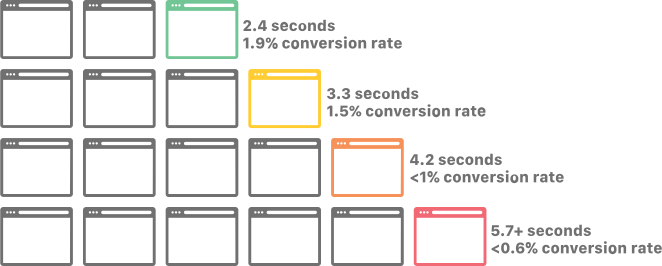
Speed remains one of the strongest conversion drivers.
Slow stores kill revenue.
Research consistently shows that even one-second delays reduce eCommerce conversion rates significantly.
At WIRO, we frequently see brands lose conversions due to:
- Bloated themes
- Poor app management
- Oversized media
- Excessive JavaScript
- Weak Core Web Vitals
In many cases, technical optimisation alone creates measurable conversion lifts.
Why Site Speed Matters More in 2026
Acquisition costs continue rising across paid media.
That means inefficient storefront performance now has a direct impact on profitability.
The brands improving retail revenue fastest are increasingly focusing on:
- Faster storefront architecture
- Technical SEO performance
- Better Core Web Vitals
- Lightweight Shopify development
- Smarter app ecosystems
As acquisition costs continue rising, improving storefront performance has become one of the fastest ways to improve retail profitability. In fact, many brands underestimate how slow Shopify stores directly reduce eCommerce revenue and conversions.
AI-Driven Personalisation
Generic eCommerce experiences are underperforming.
In 2026, high-growth brands increasingly rely on AI-driven personalisation for:
- Product recommendations
- Dynamic merchandising
- Predictive search
- Personalised collections
- Intelligent upsells
- Email segmentation
Customers now expect relevance.
Brands failing to personalise experiences will continue seeing weaker conversion rates eCommerce-wide.
Flexible Payment Options
Buy-now-pay-later has become standard.
Consumers increasingly expect:
- Shop Pay
- Apple Pay
- Google Pay
- Klarna
- Clearpay
- PayPal Express
.png)
Trust & Social Proof
Trust remains a massive conversion factor.
High-performing Shopify brands invest heavily into:
- Reviews
- UGC
- Creator content
- Social proof
- Transparent delivery information
- Clear returns policies
How to Improve eCommerce Conversion Rates
1. Improve Product Page UX
Most eCommerce conversion problems begin on the PDP.
Focus on:
- Better imagery
- Clearer benefits
- Faster load times
- Better sizing guidance
- Stronger social proof
- Improved CTA hierarchy
2. Simplify Checkout
Every extra step lowers conversion rates for eCommerce stores.
Focus on:
- Guest checkout
- One-click payments
- Autofill
- Fewer form fields
- Clear shipping expectations
- Faster checkout loading
Checkout optimisation often produces the quickest CRO wins.
3. Prioritise Mobile UX
Mobile traffic dominates eCommerce.
But many stores still treat mobile as secondary.
Your mobile experience should be designed first, not adapted later.
The brands improving retail revenue fastest in 2026 are heavily investing in mobile-first eCommerce experiences.
4. Reduce Technical Bloat
Apps, scripts and poor development decisions quietly hurt eCommerce conversion rates.
Technical optimisation should include:
- Core Web Vitals improvements
- Script reduction
- Image optimisation
- Theme efficiency
- App auditing
5. Run Continuous CRO Testing
Continuous experimentation around:
- Headlines
- PDP layouts
- CTAs
- Checkout flows
- Offers
- Bundles
- Navigation
…is what separates average stores from elite performers.
What Is Considered a Good eCommerce Conversion Rate?
A “good” eCommerce conversion rate depends heavily on industry, traffic quality and AOV.
However, general benchmarks look like this:
For Shopify Plus brands investing seriously into CRO, 4%+ is increasingly achievable.
But reaching those numbers requires far more than changing button colours.
It requires operational, technical, UX, merchandising and customer experience alignment.
Why Conversion Rate Optimisation Matters More Than Traffic in 2026
Many eCommerce brands still default to the same growth strategy:
Buy more traffic.
But rising acquisition costs across Meta, Google, TikTok and influencer marketing are making that approach increasingly expensive.
The smarter strategy is improving retail profitability through better conversion efficiency.
If your store can convert more visitors without increasing acquisition spend, every marketing channel becomes more profitable.
That’s why CRO has become one of the highest ROI growth channels in eCommerce.
At WIRO, we increasingly see brands treating CRO as a core revenue function rather than a design exercise.
The brands scaling most efficiently are combining:
- CRO strategy
- Technical optimisation
- UX improvements
- Data analysis
- Merchandising optimisation
- Mobile-first experiences
- Continuous experimentation
That combination consistently outperforms brands relying purely on paid traffic growth.
Final Thoughts
Benchmarks help identify where your store sits. But they’re not the goal.
The real opportunity comes from understanding why your eCommerce conversion rates look the way they do.
At WIRO, we’ve seen brands dramatically outperform average eCommerce conversion rate benchmarks through:
- Better mobile UX
- Faster storefront performance
- Smarter CRO testing
- Improved product merchandising
- Technical optimisation
- Checkout simplification
Need Help Improving Your Shopify Conversion Rate?
Book a CRO and Shopify performance review with WIRO to uncover where your storefront is losing revenue and where the biggest conversion opportunities exist.


.png)